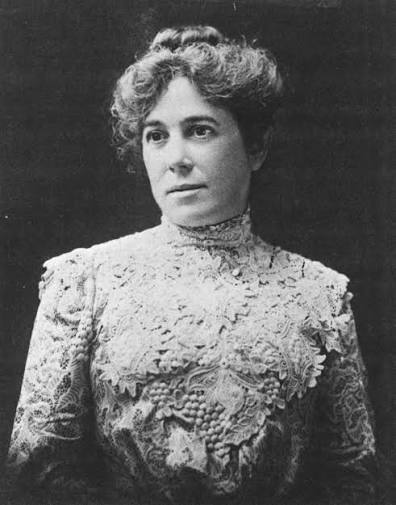
 Harriet May Mills (August 9, 1857 – May 16, 1935) was an eminent American suffragist, civil rights advocate, and trailblazing politician whose life and career helped reshape
the political landscape of New York State and the United States.
Harriet May Mills (August 9, 1857 – May 16, 1935) was an eminent American suffragist, civil rights advocate, and trailblazing politician whose life and career helped reshape
the political landscape of New York State and the United States.Partner Isabel Howland
Queer Places:
Cornell University (Ivy League), 410 Thurston Ave, Ithaca, NY 14850
1074 W Genesee St, Syracuse, NY 13204
North Pitcher Cemetery, North Pitcher, NY 13124, USA
Harriet May Mills (August 9, 1857 – May 16, 1935) was an eminent American suffragist, civil rights advocate, and trailblazing politician whose life and career helped reshape
the political landscape of New York State and the United States.
Born in Syracuse, New York, to prominent abolitionist and freethinker Charles DeBerad Mills and Harriet Anne Smith, Mills grew up in an environment deeply committed to social justice. Her family home was an active station on the Underground Railroad, sheltering individuals escaping chattel slavery. This progressive upbringing instilled in her a lifelong dedication to human rights, equality, and radical reform.
Mills pursued higher education at Cornell University, entering just two years after the institution first opened its doors to women. She graduated in 1879, embarking initially on a career as a schoolteacher near Boston and distinguishing herself as an early expert on the poet Robert Browning. Her path shifted dramatically toward political activism in 1886 after hearing pioneer suffragist Lucy Stone speak. Galvanized, Mills aligned herself with the National American Woman Suffrage Association (NAWSA) and threw herself into the movement. She quickly emerged as a powerhouse organizer, lecturer, and strategist, working side-by-side with national icons such as Susan B. Anthony, Elizabeth Cady Stanton, and Carrie Chapman Catt.
Returning to Syracuse, Mills anchored the suffrage movement in New York. She organized the 1892 state convention for the New York State Woman Suffrage Association (NYSWSA), later serving in nearly every major leadership capacity, including recording secretary, vice president, and state president. Her family home on West Genesee Street in Syracuse effectively functioned as the headquarters for the New York Political Equality League and later the NYSWSA. Beyond New York, Mills campaigned nationally, lending her organizing expertise to state suffrage referendums in places like Ohio, Michigan, and California, and testifying before the United States Congress.
Following the ratification of the Nineteenth Amendment in 1920, Mills transitioned seamlessly into electoral politics. Breaking monumental barriers, she ran as the Democratic candidate for New York Secretary of State in 1920, marking the first time a woman ran for major statewide office in New York on a major party ticket. A loyal and influential Democrat, she founded the Onondaga County Women's Democratic Club, served as a delegate to the 1920 Democratic National Convention, and worked closely with Franklin D. Roosevelt and Al Smith. In 1933, she capped off her political career as a presidential elector, casting her vote for FDR. In recognition of her lifetime of service, the Harriet May Mills Women's Building was dedicated on the grounds of the New York State Fair in Syracuse in 1934. She passed away the following year at the age of 77.
While Harriet May Mills never married—a common choice for first-wave feminists who wished to retain legal control over their property and independence—her personal life is deeply intertwined with the history of nineteenth and early twentieth-century same-sex partnerships among women.
During her undergraduate years at Cornell University, Mills met Isabel Howland (the niece of prominent women's rights activist Emily Howland). The two women became romantic partners and lifelong companions. In the context of the era, their relationship exemplifies a "Boston marriage"—a term used to describe two independent women sharing a life, a home, and emotional devotion outside of traditional heterosexual frameworks.
Howland and Mills operated not only as romantic partners but also as inseparable professional colleagues. They traveled extensively together, shared domestic spaces, and collaborated shoulder-to-shoulder within the suffrage and reform movements. Their partnership provided Mills with the emotional stability and collaborative synergy necessary to sustain decades of grueling activist labor. Modern LGBTQ historiography recognizes figures like Mills and Howland as vital components of queer history, preserving the legacy of autonomous women who forged deeply committed, loving relationships with one another while simultaneously spearheading structural changes for women's citizenship and equality.
References:
Support this project
This website is a passion project researched, developed, and funded entirely by me. If you find the content valuable and would like to help support the ongoing research and hosting costs, any contribution is deeply appreciated.
Thank you for keeping this independent resource alive!
My books on Amazon: Elisa Rolle's books